Twenty Answers
The Magic 8-Ball That is Your Brain
Our brains are a magic 8-ball. You ask a question, you give it a shake, a little blue truth floats up out of the murk, and you read it and nod and feel temporarily certain about something. Then you shake it again, same exact sequence of words, and a different truth surfaces, and you nod at that one too, regardless of whether it conflicts with the first one. We do this constantly all day, and I don’t think we are stopping to ask the obvious and faintly horrifying question, which is why on earth we trust a toy this much.
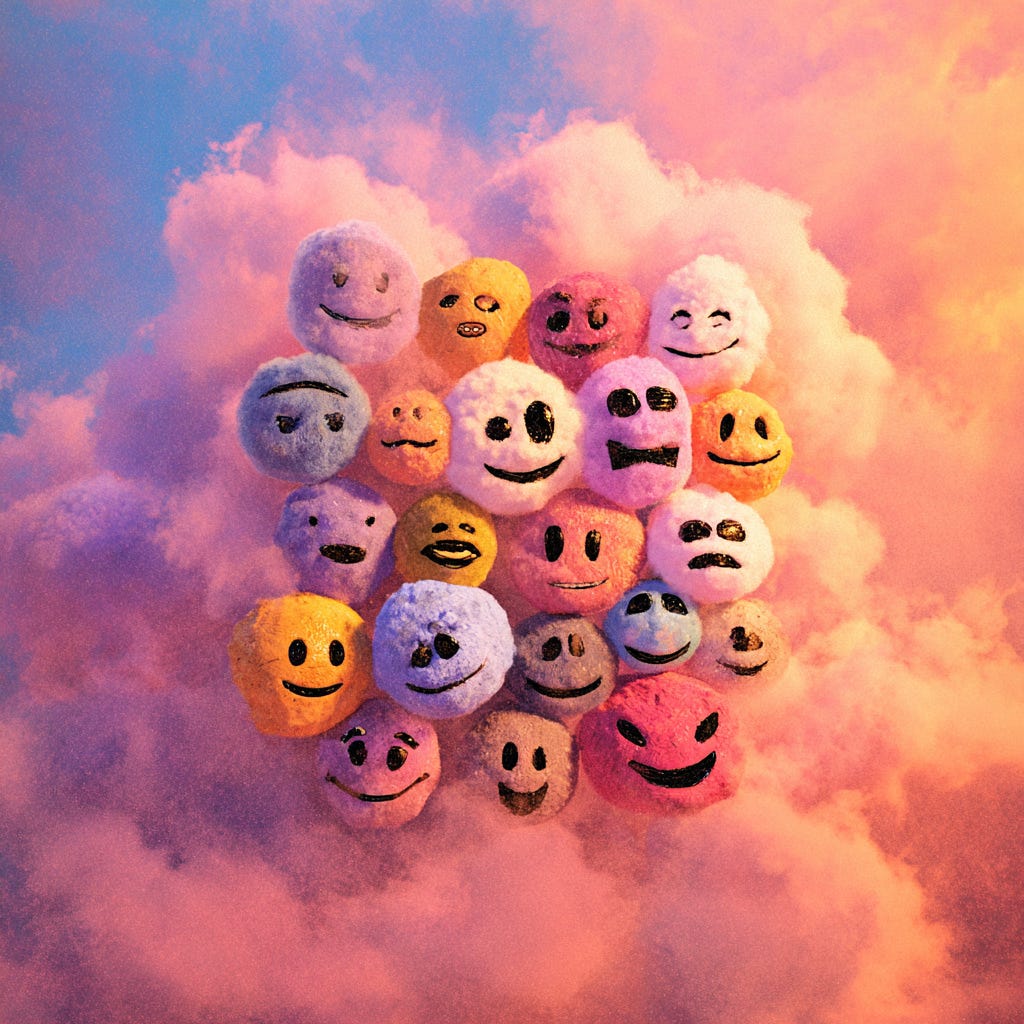
Here is what I think is actually going on in there, and I want to lay it out deliberately because the order matters and the order is more or less the thing.
A word, the actual word, the little fistful of sound or the smudge of ink, is a fixed object. It is (arguably) the atomic unit of language and there are a finite number of them. You could in theory write them all down, and people have tried, and the books are heavy. The word itself just sits there being inert, patient, dumb. It does nothing & means nothing. It is a doorknob, and a doorknob is not a door. Then your mind shows up and turns the knob.
What the mind does next is interpretation, which is a private event. It happens inside one skull, in the dark, witnessed by nobody, and it is functionally bottomless. You can take a single word, like “home” or “good” or your own mother’s name, and turn it over inside yourself indefinitely, and every time you turn it the light catches a slightly different face, and you will not, not in eighty or a hundred years of turning, run out of faces. There is no end to this process. There is an end to you, and you will arrive at that one first. Interpreting feels infinite, and in a slippery and slightly insidious way it sort of is, though the infinity I mean is less like the voluminous sprawl of stars on a cloud-free night and more a dark, dank hallway where there is always, always one more door, which I think is a smaller and lonelier kind of forever.
But none of that turning is meaning, not even one little baby bit of it. All your beautiful private thinking is only potential, only weather inside your head, and weather inside your head changes nothing and is known to no one and dies when you do.
But meaning! Meaning is thin. Meaning is the rare and improbable event where something you dug up alone in the dark gets out of your mind and lands intact in somebody else’s, and the two of you, for one second, are holding the same interpretation of the same word. There is a proverbial handshake in every meaning, two private things lining up for once, a phenomenological overlap. It takes two by definition, because whatever you hold alone in there, however vivid, however certain you are of it, never gets to graduate into a meaning until somebody else is holding it too.
So you end up with this strange and beautiful lopsidedness. The interpretations are enormous things, the dark water or the endless hallway, but sealed inside individual people and nearly all of it lost. The meanings are small things like lit windows on a New York City night, and there are a staggering number of those, billions stacked on billions, more than anyone could ever count, and it is still miniscule next to the ocean of interpretations it crawled out of. Meaning is a thin shared crust on top of a vast private planet of interpretations.
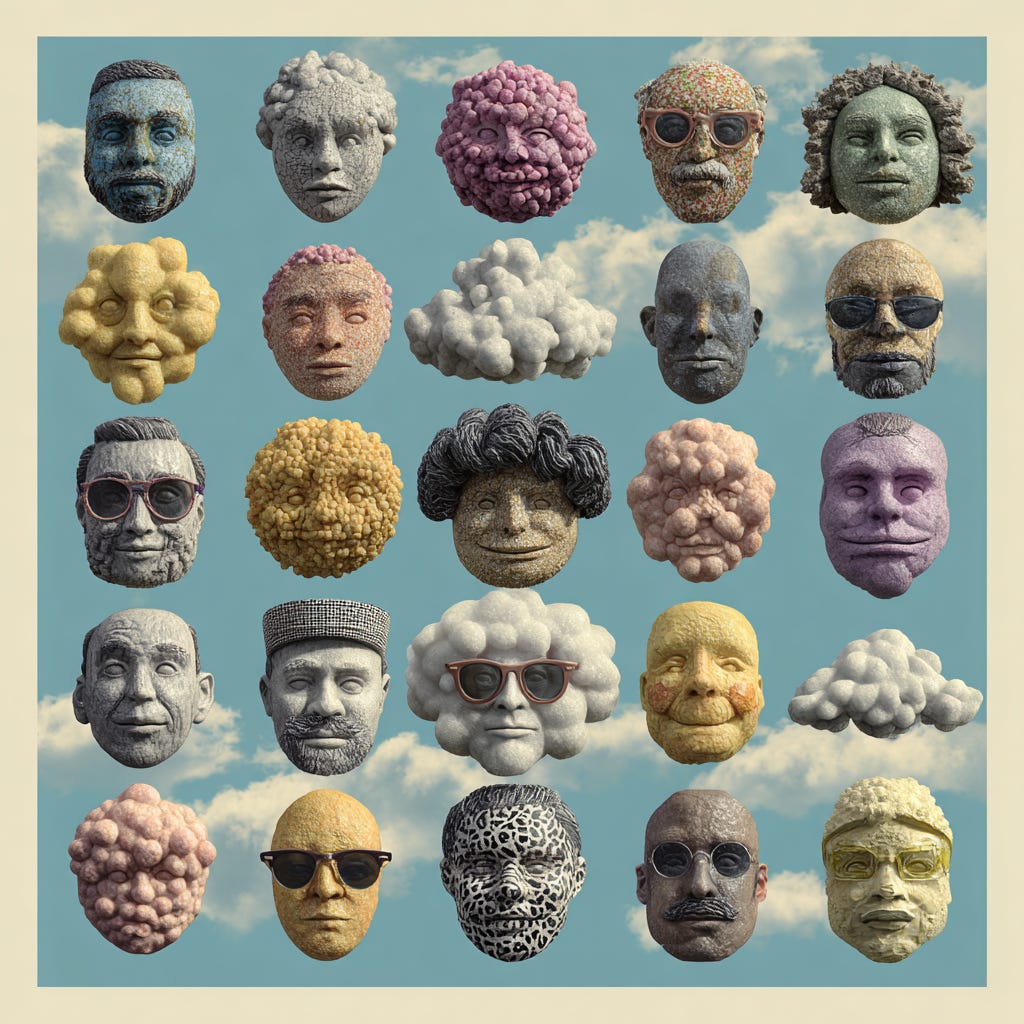
The part that probably irks you (it certainly irks me) is that nobody is in charge of the crust. There is no Department of Meaning. Nobody mints a meaning, nobody signs off, no committee sits in a room somewhere stamping things as official and rejecting the rest. The whole shared world of meanings got laid down one handshake at a time, and the handshakes were stacked and stacked and stacked by people who mostly did not know each other and are overwhelmingly very dead. The dictionary, which prances around like a lawbook, is nothing more than a pretentious stenographer, an archaeologist of meaning. It writes down the most prominent layers of handshakes and pretends to have discovered them. There is no absolute monarch of “home.” There is just everyone who ever held that word up to someone else and got a nod back, and the nods piled up a whole bunch until we all think we know what we mean when we talk about home, and that’s just how language works. It’s reassuring, I guess.
But now let’s be honest with ourselves for a moment…
I have written before, at tedious length, about how an analogy is allowed to walk you right up to a question and is under no circumstances allowed to answer it, and how the warm click of a metaphor fitting is precisely the sensation you should distrust. And here I am, deep into this essay, leaning my entire body weight on a magic 8-ball. So let me catch myself before one of you catches me, because the 8-ball metaphor is, in fact, a lie.
A real magic 8-ball has twenty answers. They are printed on 20 little plastic faces bobbing around in blue dye, and that is the total universe of things it will ever say to you (if you weirdly still have one, I encourage you to go shake it and find out). It is a finite object. Which means that the second you actually press on this metaphor, you’ll find the precise opposite of everything I just told you, because the objecct of the metaphor is in actuality just a gadget sold at a Kohl’s register.
That is the trap, and I walked into it halfway on purpose, the same way you might press on a bruise to check it is still there even though you know it’s gonna hurt like shit. The 8-ball is perfect for the “front door”, the shaking, the turning of the problem, the surfacing of the root causes, the cheap little hit of certainty that hints at a potential solution. But it is useless the moment we start solving because that is exactly where it lies to you. So I think we can keep the part where we shake the 8-ball and throw away the twenty answers.

Which finally clears the floor for the root question; why do you trust the stupid thing at all (your brain, that is), when it will not give you the same interpretation twice and carries almost everything it comes up with straight to your grave with you?
Best I have got is this. You do not trust the shake, you simply can’t afford to. That interpretation happens alone in your mind and it changes constantly. What you trust, what you have always quietly trusted without ever quite admitting it, is the meaning. That freakish little moment when the interpretation you dug up alone turns out to be one somebody else dug up too, and it lands, and for one second you are not making the whole thing up by yourself. That second is the only solid ground there is. Everything you feel sure of, you feel sure of because at some point the meaning happened and a second person held the same interpretation as you.
And most of that meaning that you lean on got done long before you ever showed up. That little lit crust, the “good” stuff you can actually trust, you did not build. Not one brick of it. Every word you have ever opened your mouth around arrived already crammed full of meaning, pre-stocked with every interpretation every dead stranger before you held up and got a nod for. A whole genealogy of handshakes, and you were not invited to a single one (or at most maybe 1 or 2). You inherited a fully furnished language and you have spent your whole life walking around inside it like you own the place.
And if you ever doubt the meaning is real, there is proof. Some of those handshakes reached you from a very long way off. You can be sitting in a chair right now, catching a meaning that one specific person threw three hundred years ago, from inside a brain that has been dirt for most of those centuries, and it miraculously still lands cleanly, all the way across all that dead air.
What you make, alone, in the dark, all day and probably most of the night (assuming we include dreaming), is oceans of interpretation, and the brutal fucking arithmetic of it is that almost none of yours will ever become meaning, because becoming meaning requires another person to reach out and catch it, and they mostly will not, because they are far too busy turning their own words over in their own dark, drowning in their own ocean, trying with everything they have to shove one wet face of one word across the gap and into a second mind before the lights go click.
You WILL manage it a handful of times. Those few times are the entire reason for language. The rest of it, everything you almost said, every face you turned up alone and never once got to hand to another living person, just sinks quietly with you.
Shake again homie.
About the Author
Sam Hilsman is the CEO of CloudFruit® and a perpetual student of the world. I build software, write things, and read a bunch.